
Developing a Marketing Strategy to Support Business Goals in 2026
In 2026, a structured marketing strategy is no longer optional for small to medium-sized businesses. It is foundational to predictable revenue growth and long-term competitive positioning.
Many organizations increase marketing activity without first clarifying strategic direction. They launch advertising campaigns, redesign websites, post consistently on social media, and invest in SEO. Yet despite increased effort, results remain inconsistent. Leads fluctuate. Conversion rates stall. Marketing feels busy but disconnected from business performance.
The issue is rarely effort. The issue is structure.
A marketing strategy must begin with clear business goals. Without alignment between marketing and leadership objectives, even well-executed tactics fail to deliver measurable growth.
In a competitive market influenced by AI search, digital saturation, and rising acquisition costs, strategy provides clarity and control.
What Is a Marketing Strategy in 2026?
A marketing strategy is a documented framework that defines:
- Who your business serves
- What differentiates you
- Which channels you will prioritize
- How messaging will be structured
- What measurable outcomes will define success
In 2026, a marketing strategy must also address:
- AI search visibility
- Zero-click search behavior
- First-party data development
- Integration across channels
- Measurable KPI tracking
Marketing strategy is not a campaign. It is the foundation upon which campaigns are built.
Why Marketing Strategy Must Align with Business Goals
A marketing strategy should support:
- Revenue growth targets
- Profit margin objectives
- High-value service priorities
- Customer acquisition efficiency
- Geographic expansion plans
- Brand positioning goals
For example, if a company’s business goal is to increase sales by 25 percent, its marketing strategy must prioritize authority content, SEO visibility, and targeted messaging rather than broad awareness.
When business goals are unclear, marketing decisions become reactive. Budgets are allocated based on trends rather than measurable opportunity.
The Four-Phase Marketing Strategy Framework
At Activation Digital, we structure marketing strategy development into four disciplined phases.
Phase 1: Discovery and Alignment
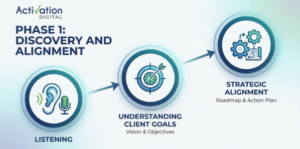
Discovery clarifies direction before execution begins. This phase includes:
• Leadership interviews
• Competitive landscape analysis
• Ideal customer profile definition
• Market positioning audit
• Revenue modelling and KPI review
Discovery ensures the marketing strategy supports business growth rather than disconnected tactics.
Phase 2: Strategy Development
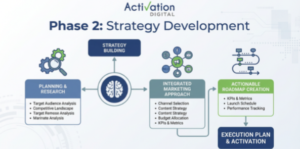
This phase defines the strategic foundation of your marketing strategy. It includes:
• Brand positioning documentation
• Proposition refinement
• Messaging framework development
• Audience segmentation
• Channel prioritization
• KPI mapping
In 2026, a marketing strategy must also consider AI search optimization and structured content visibility.
Phase 3: 12-Month Marketing Plan Development
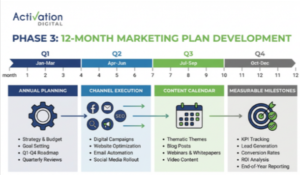
Strategy becomes actionable through a documented marketing plan. This includes:
• Campaign calendar
• Content roadmap
• SEO plan
• Email marketing cadence
• Paid advertising allocation
• Reporting dashboard creation
A structured marketing plan provides accountability and measurable benchmarks.
Phase 4: Execution and Optimization
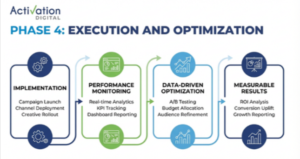
Marketing strategy is dynamic. Execution includes:
• Ongoing SEO optimization
• Content publishing
• Paid campaign management
• Conversion tracking
• Quarterly strategy reviews
Integration Across Channels
Modern marketing strategy requires integration. SEO must align with content. Content must align with email marketing. Email marketing must support lead nurturing. Paid advertising must reinforce positioning. Fragmented marketing reduces efficiency. Integrated marketing strategy increases return on investment.
Measurement and Accountability
A strong marketing strategy includes measurable KPIs such as:
- Organic traffic growth
- Lead conversion rate
- Cost per acquisition
- Customer lifetime value
- Revenue attribution
Without measurable tracking, marketing decisions lack clarity. Marketing strategy in 2026 must be data-informed.
How Activation Digital Can Build Your Marketing Strategy
If your marketing feels active but disconnected from measurable revenue growth, you may lack a documented marketing strategy aligned with your business goals.

Activation Digital works with small to medium-sized businesses across Guelph, Ontario, Canada, and beyond to develop structured marketing strategies that prioritize clarity, integration, and measurable performance. We begin with leadership alignment and discovery, then develop a documented roadmap tailored to your industry and objectives.
Book a Marketing Strategy Consultation with Activation Digital today. We will evaluate your current marketing performance, identify strategic gaps, and outline a clear path toward sustainable business growth.
Frequently Asked Questions
- What is a marketing strategy?
A marketing strategy is a documented framework that defines how a business will reach its target audience, communicate its value, and achieve measurable revenue growth. It outlines positioning, messaging, channel priorities, and performance benchmarks.
- How does a marketing strategy differ from a marketing plan?
A marketing strategy defines direction and positioning. A marketing plan outlines specific campaigns, timelines, and budgets required to execute that strategy.
- Why is marketing strategy important in 2026?
In 2026, AI search, digital competition, and privacy regulations require structured planning. Without strategy, businesses struggle to maintain visibility and consistent lead generation.
- How often should a marketing strategy be reviewed?
Quarterly reviews are recommended to assess performance and adapt to market changes. Annual updates ensure alignment with evolving business goals.
- Can a marketing strategy improve profitability?
Yes. Clear positioning, targeted messaging, and measurable tracking reduce wasted spend and improve conversion efficiency, which supports profitability.